Wildfire Challenge
Qubits vs Wildfire Blights: A New Frontier in Firefighting
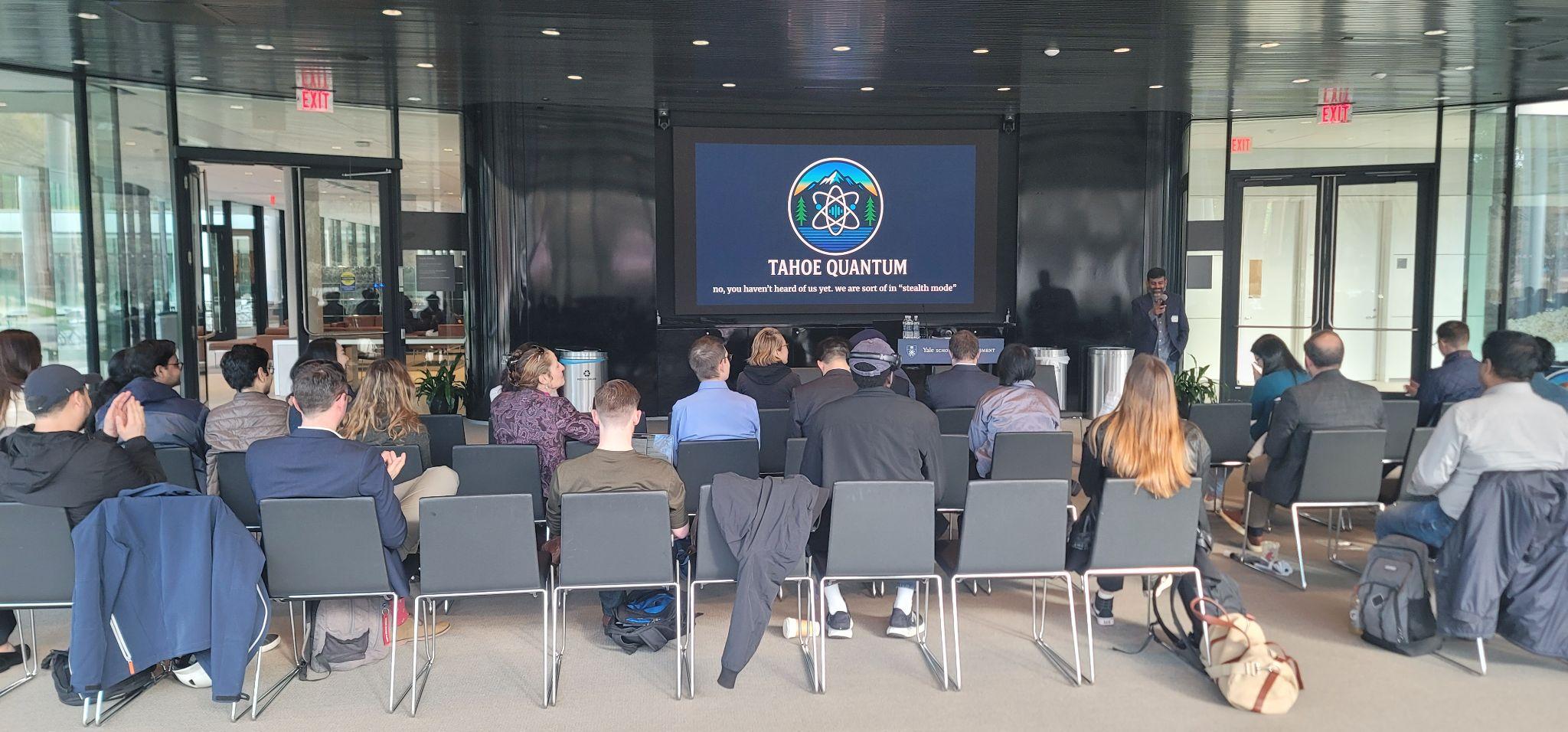
The smell of smoke, even a phantom one carried on the wind from miles away, has a way of unsettling the soul. Increasingly across the globe, the threat of wildfire is no longer a distant concern but an encroaching reality. From the recent scare of the 2024 Davis Fire near Reno to the infernos in Los Angeles and Maui, the message has been stark: wildfires are a global crisis demanding new lines of defense. It was from this very urgency that Tahoe Quantum was founded, and hosted a challenge at the 2025 YQuantum hackathon at Yale University.
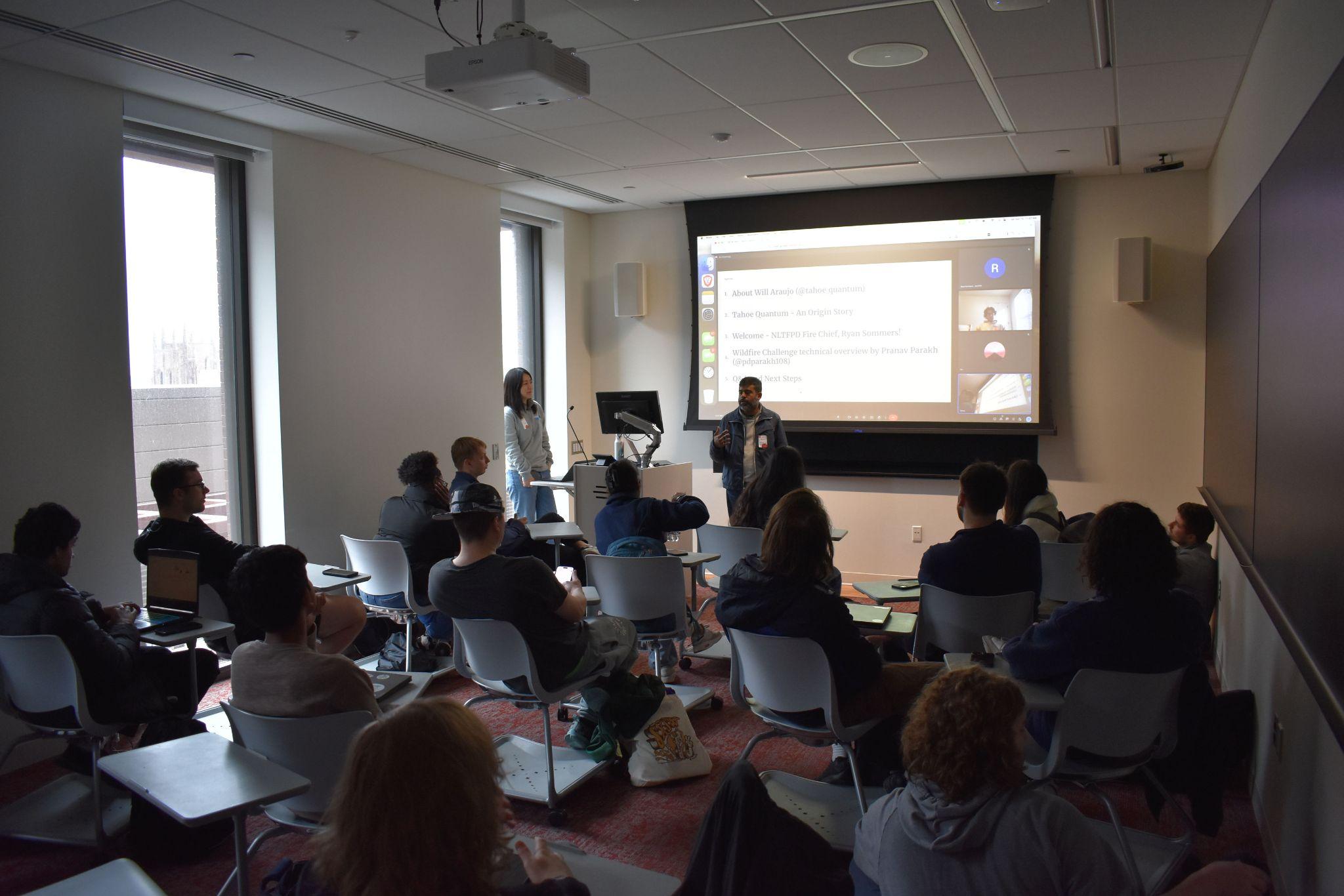
The event kicked off with a word from Fire Chief Ryan Sommers of the North Lake Tahoe Fire District. "Every year, the fires get bigger, they move faster, and the decisions we have to make get tougher," Chief Sommers shared with the assembled innovators. "We're looking at where to send our crews, how to evacuate communities with minutes to spare, how to predict the unpredictable.” Will Araujo, founder of Tahoe Quantum, echoed this sentiment. "This isn't just an academic exercise for us," Araujo stated. "We need to push the research boundaries now to quickly develop the tools needed so we can prevent wildfire disasters.”
And so the Hackathon began. The premise of the hackathon was ambitious: could the nascent power of quantum computing be used to tackle the complexities of wildfire management?
Students from all across the USA would organize in teams of 3-5, and would have 24 hours to attempt to use quantum computing to address this problem.
The challenge presented to students was to take a pressing real-world wildfire scenario—like optimizing the deployment of scarce firefighting resources, planning lightning-fast evacuations, or dynamically monitoring a fire's unpredictable spread—and translate it into a format that quantum computers can effectively process.
This translation primarily involved framing these problems as Quadratic Unconstrained Binary Optimization (QUBO) problems. Think of a QUBO as a specific mathematical way to represent decision-making processes where you have a series of yes/no choices (that's the "binary" part), and your goal is to find the combination of choices that results in the best possible outcome, often by minimizing a "cost" or maximizing a "benefit."
Once a problem was in this QUBO format, teams were then guided to explore solutions using approaches like the Quantum Approximate Optimization Algorithm (QAOA). Though quantum computers can solve a vast array of potential problems, algorithms like QAOA are specifically designed to run on quantum computers to solve QUBO problems in a potentially very efficient manner!
Underpinning the hackathon's challenge was a dive into specific quantum methodologies well-suited for complex optimization. Participants were guided to frame their chosen wildfire problems—whether direct resource allocation or monitoring tasks initially modeled as Maximum Independent Set (MIS) problems—into the QUBO framework.
The essence of a QUBO problem is to find the binary variable vector that minimizes a quadratic function of the form where the matrix encodes the relationships and weights between the variables. For Quantum Annealing, this QUBO is mapped onto a problem Hamiltonian . The system then evolves from an easily prepared initial Hamiltonian to via a time-dependent process . If this evolution is slow enough (adiabatic), the system aims to naturally settle into the ground state of , which corresponds to the optimal solution of the QUBO.
Alternatively, the Quantum Approximate Optimization Algorithm (QAOA) offers a gate-based variational approach. Here too, the QUBO is first mapped to a problem Hamiltonian, often expressed as where represents Pauli-Z operators acting on individual qubits. QAOA then iteratively builds a parametrized quantum state designed to encode low-cost solutions. This is achieved by starting with qubits in a uniform superposition, , and then applying a sequence of alternating unitary operations for a chosen number of layers, . Each layer consists of a cost unitary, , which applies phases based on the problem Hamiltonian, followed by a mixer unitary, , where the mixer Hamiltonian is commonly , with being Pauli-X operators. The final state after layers is . The crucial step involves a classical outer loop: the angles are optimized by a classical computer to minimize the expectation value , thereby increasing the probability of measuring a bitstring that corresponds to an optimal or near-optimal solution to the original QUBO problem.
The beauty of the QUBO framework lies in its versatility, as many complex decision-making processes can be mapped onto it. Once a problem is in QUBO form, it becomes possible to explore how quantum annealers or gate-based algorithms like QAOA might find better and faster solutions compared to using only classical methods.
Essentially, for the challenge, teams needed to:
- Define a specific wildfire response problem.
- Mathematically reformulate it as a QUBO.
- Employ Quantum Annealing or QAOA (often through simulators, with the option to explore real hardware via platforms like qBraid) to solve their QUBO.
- Present their findings and their potential real-world impact.
The judging criteria were multifaceted, and were focused on teams’ Technical Implementation & Use of Quantum Tools (30%), Correctness & Practicality of the solution (30%), Creativity & Innovation (20%), Presentation Quality (10%), and a comprehensive writeup (10%).
After 24 hours of non-stop hacking, teams submitted their solutions to the challenge. The results were nothing short of inspiring - the creativity, grit, and dedication that teams demonstrated to make progress towards such a difficult challenge were truly impressive. Teams then had the opportunity to present their solutions to the rest of the participants and the judges in short presentations, after which judging took place.
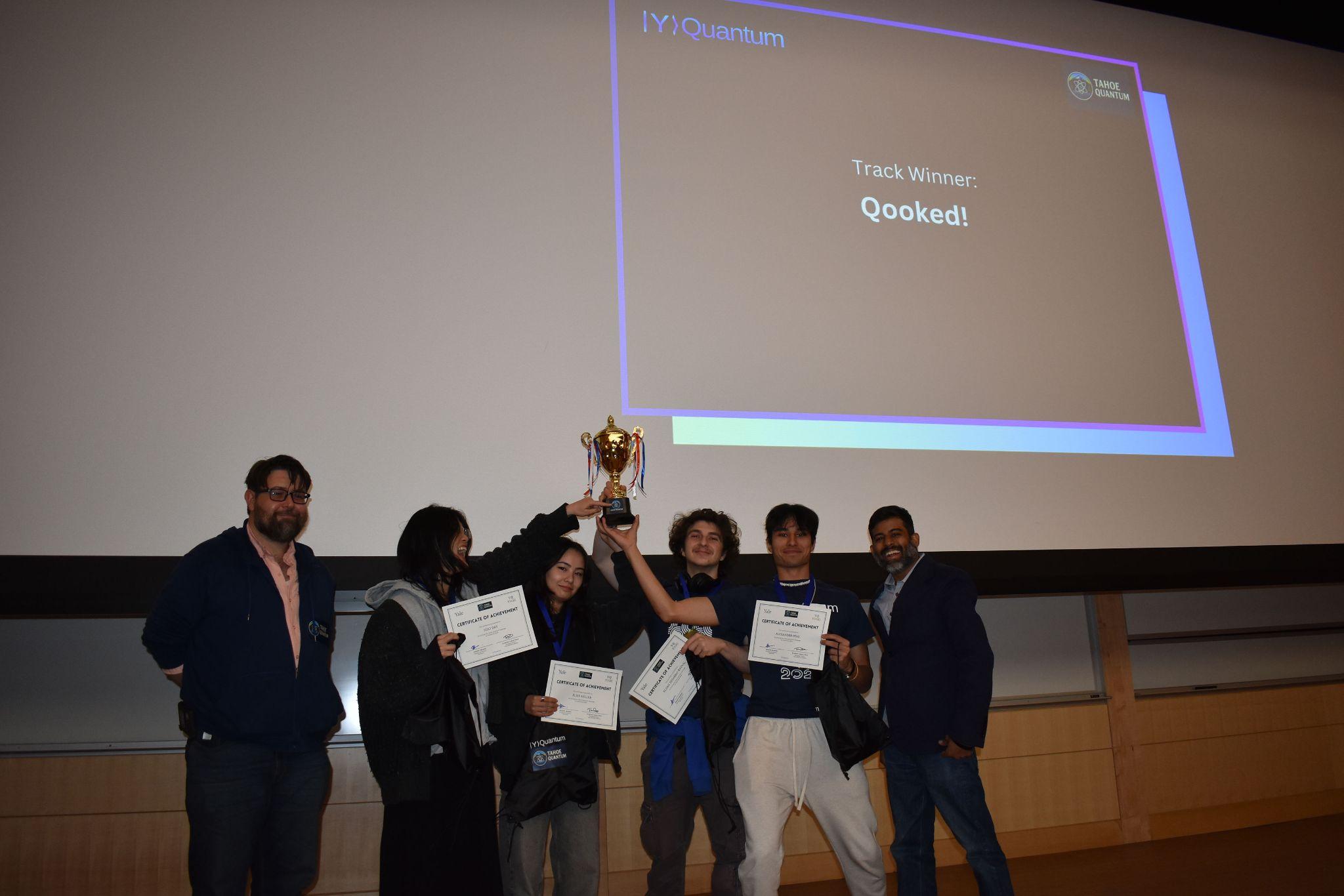
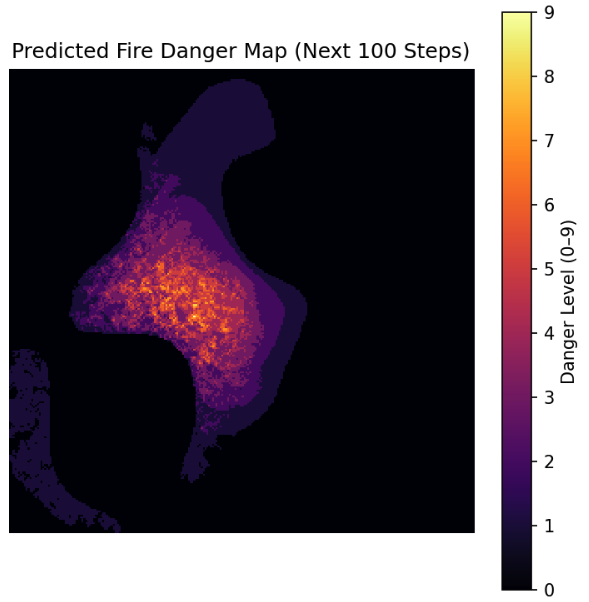
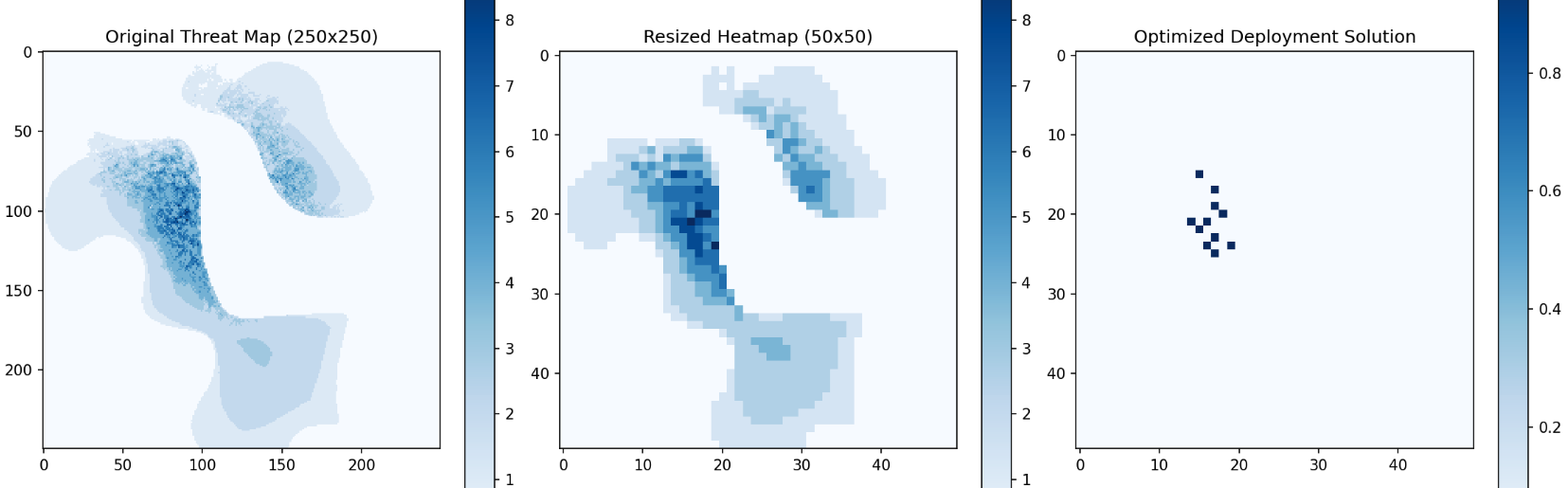
Team Qooked! clinched the top spot with a solution that ingeniously combined classical simulation with quantum optimization. First, they developed a classical simulation to model fire progression across a randomly generated city matrix. This wasn't just a simple grid; the probability of fire spread was intricately linked to factors like population density and the type of material (forest, arid land, etc.), creating a dynamic threat assessment heatmap. This heatmap was then translated into a QUBO problem. Using a simulated Quantum Annealer, Team Qooked! optimized the placement of first responders, outputting a solution that detailed where to place first responders to most efficiently fight the fire.
Github